De Quervain's thyroiditis - Case 4 |
Chronic lymphocytic thyroiditis - Case 90 |
|
Clinical data:
|
Clinical data:
|
Clinical data:
-
a 43-year old woman 6 months after delivery with mild complaints of hyperthyroidism
-
she get no therapy previously
-
TSH 0.03 mIU/L, FT4 25.6 pM/L.
|
 |
 |
 |
 |
 |
 |
 |
 |
 |
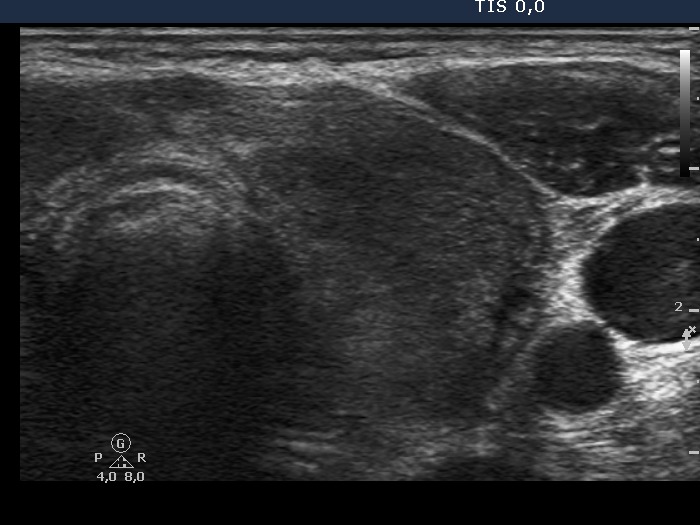
A very typical presentation of de Quervain's thyroiditis is demonstrated with the ill-defined hypoechogenic areas causing a cloudy appearance and with decreased vascularization. |
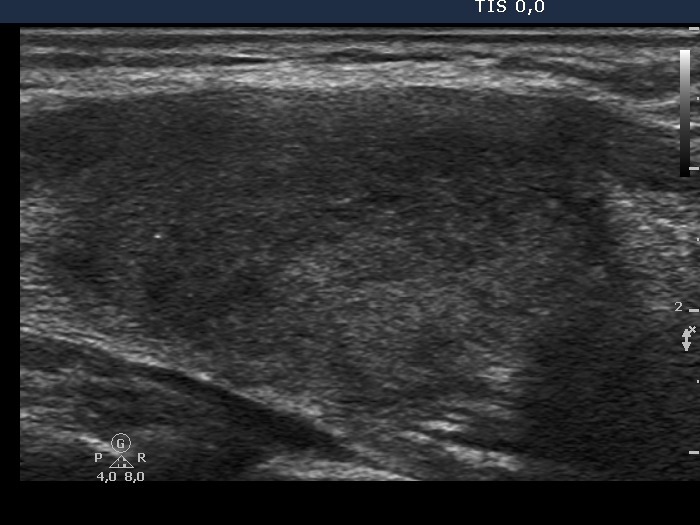
The thyroid contains tiny discrete hypoechogenic areas and presents an average vascularization. |
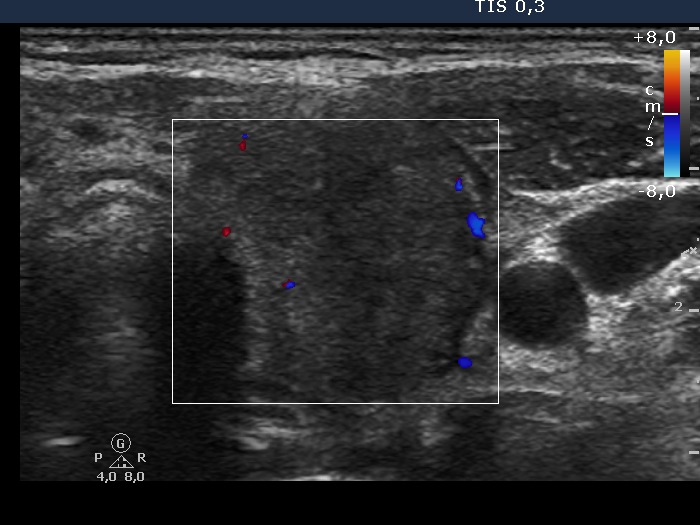
The thyroid contains discrete hypoechogenic areas and presents an increased vascularization. |
A post partum thyroiditis had to be considered in all three cases, however the time elapsed after delivery was too long to the hyperthyroid phase which occurs typical within 2 months after delivery.
Although the ultrasound pattern was almost decisive in the left case, the ineffectivity of NSAID and the unusually high level of FT4 had to be taken into account. The differential diagnostic in the middle and in the left case seems to be more simple: the patients may have either a hashitoxicosis or a Graves' disease. Cytology was performed but was not decisive in the left patient. |
ESR: 78 mm/H
CRP: 13.3 mg/L
TSAb: 0.1 U/L |
Results of additional laboratory tests
ESR: 8 mm/H
CRP: 2.1 mg/L
TSAb: 1.4 U/L |
ESR: 11 mm/H
CRP: 1.1 mg/L
TSAb: 5.6 U/L |
Final diagnosis: de Quervain's thyroiditis.
We had the patient stop the thyrostatics and a 6-week steroid therapy was started which resulted in prompt amelioration of neck complaints.
2 weeks later the FT4 level was 16.0 pM/L. 2 years after discontinuation of steroid the patient is free of complaints and the US had normalized. |
Final diagnosis: post partum thyroiditis.
We did no give any therapy. 4 months later a hypothyroidism was detected which resolved spontaneously after another 3 months. |
Final diagnosis: autoimmune thyroid disease. Graves' hyperthyroidism.
We initiated low dose thyrostatic therapy but the patient refused our suggestion. 2 years later the patient is free of complaints and is euthyroid. |


