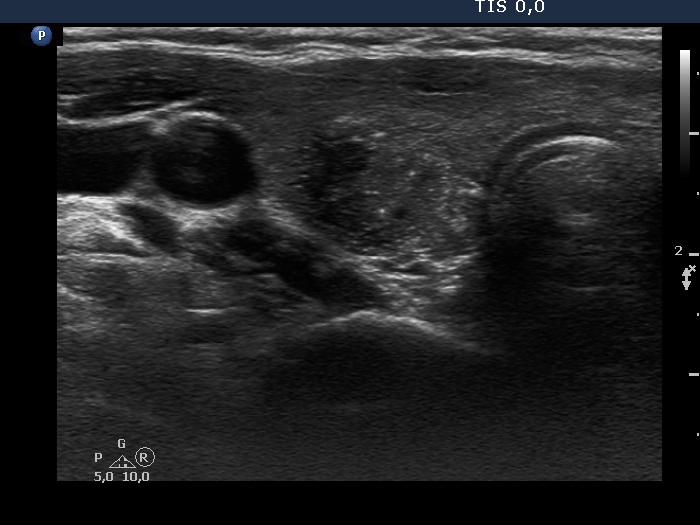
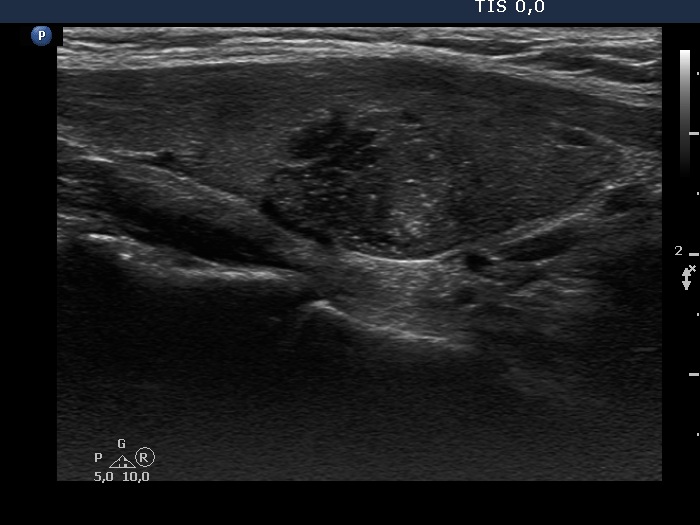
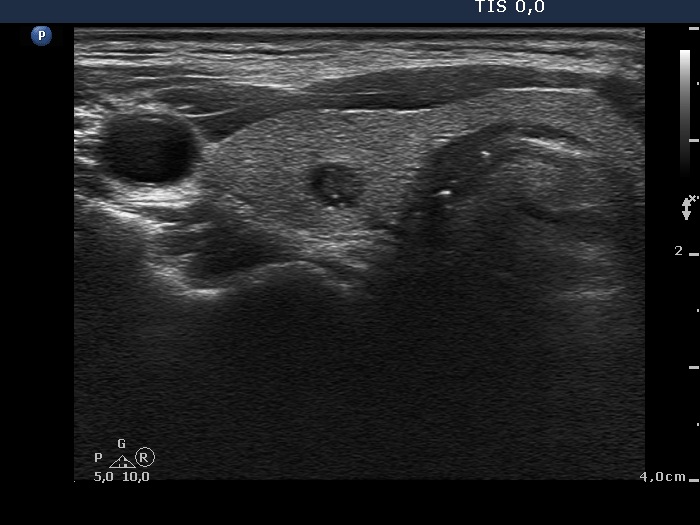
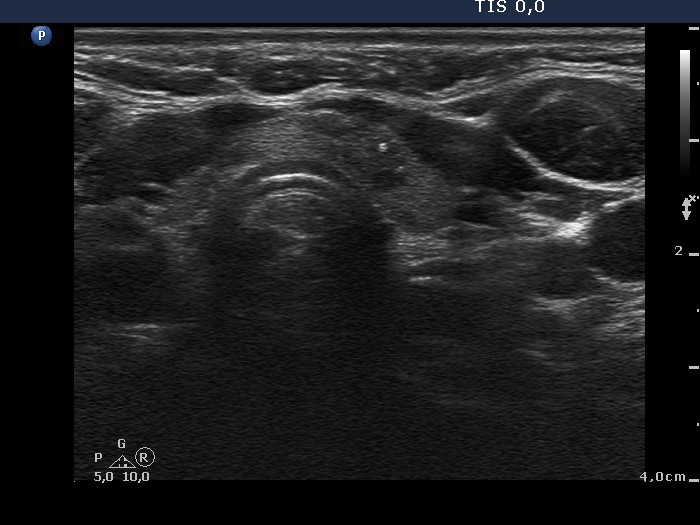
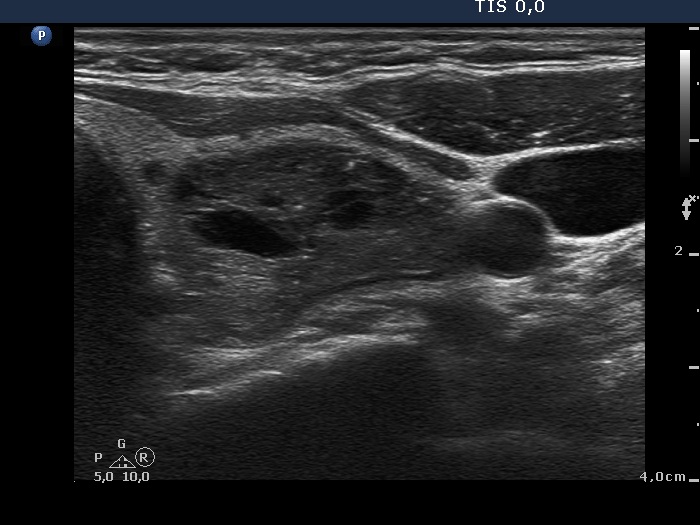
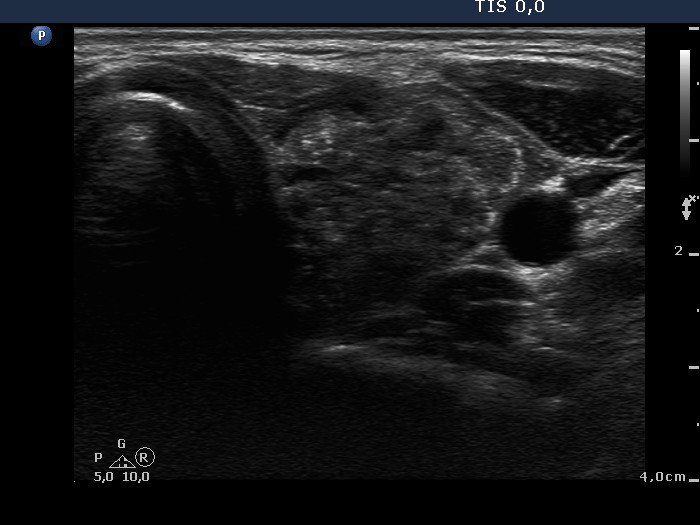
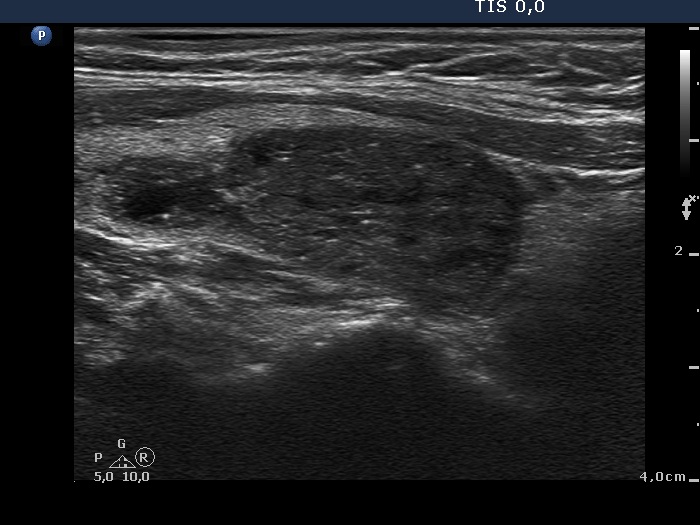
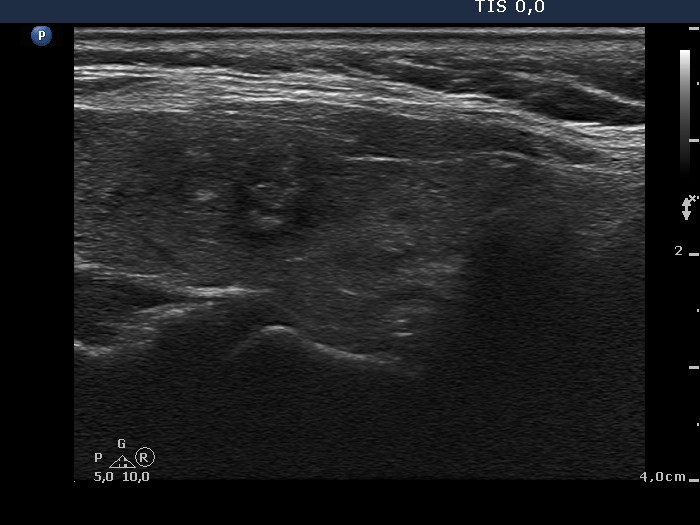
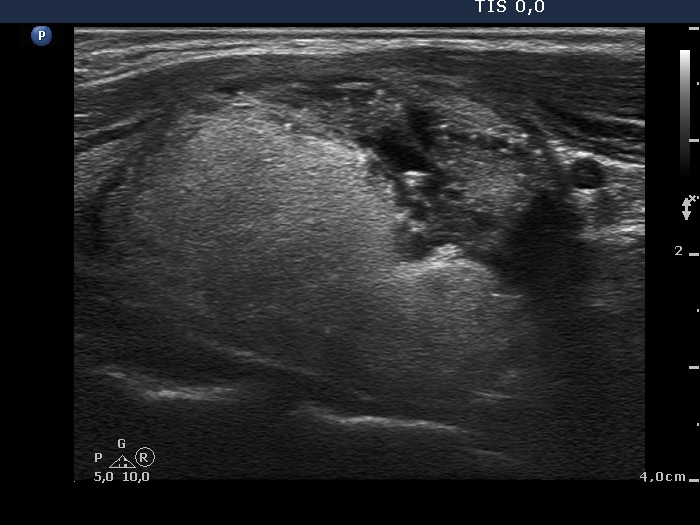
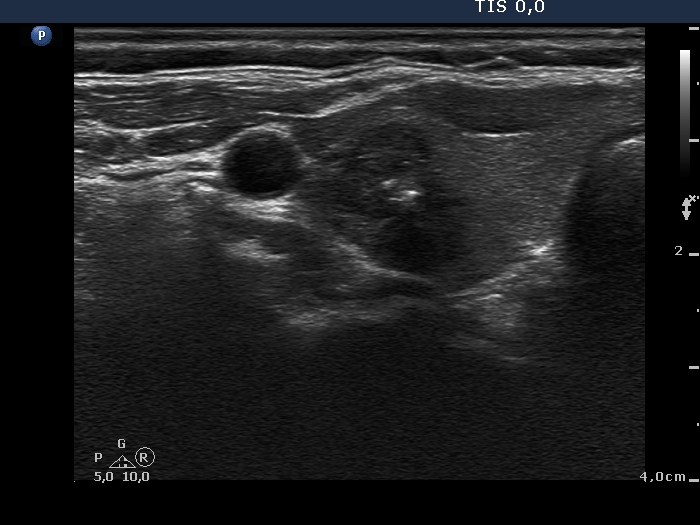
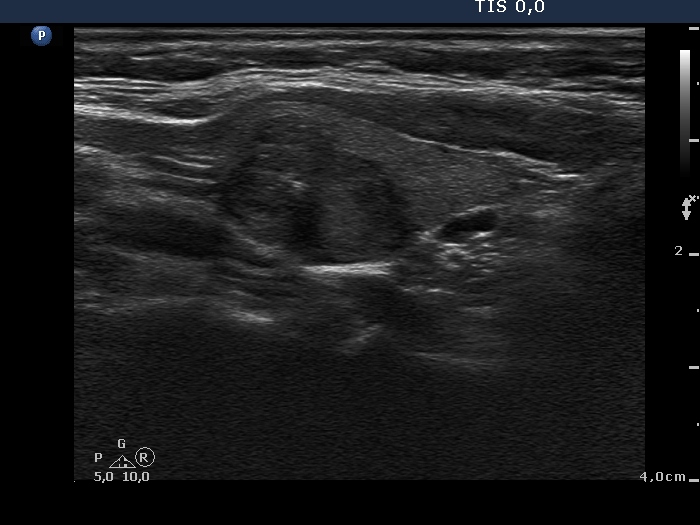
Intranodular hyperechogenic figures - Table 10 (large). Differentiation of nodules presenting hyperechogenic granules

doi: 10.24390/thyrosite.2018.ihf.10.2

Although the analysis of hyperechogenic granules is very important when we judge a nodule, there are other features takenwhich must be take into account during the interpretation of a nodule. We have to consider all of these characteristics in differential diagnostic methods. This analysis is of minimal importance until we have the opportunity and freedom to perform aspiration cytology even from the least suspicious nodule. However, the current trends try to minimize the ratio of unnecessary FNAs which put a greater responsibility on the shoulder of the ultrasonographer.

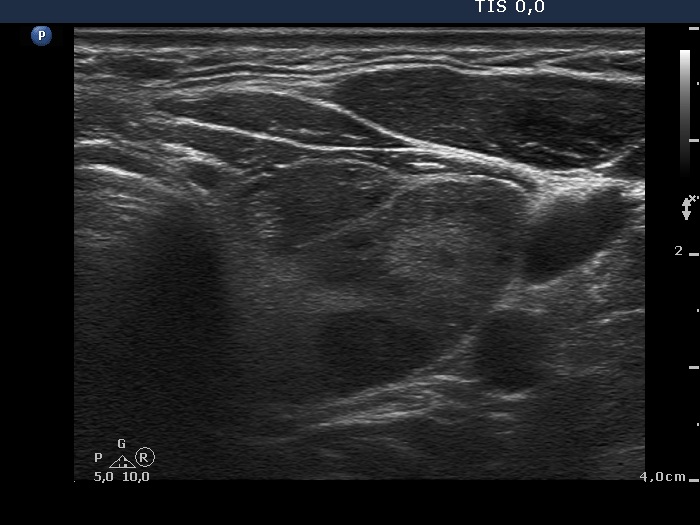
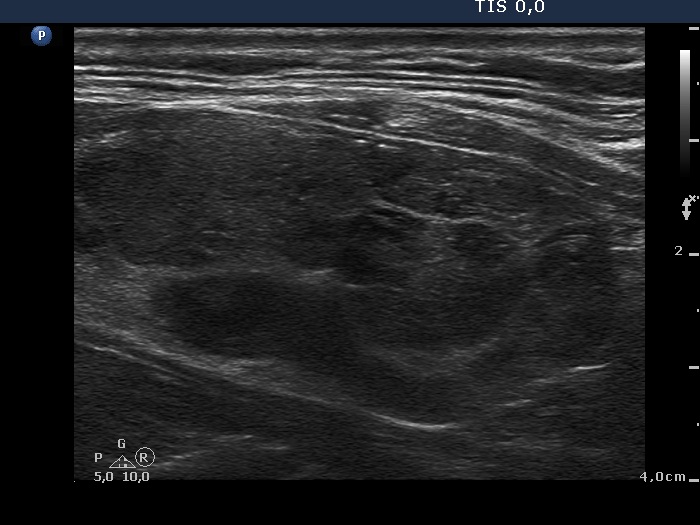
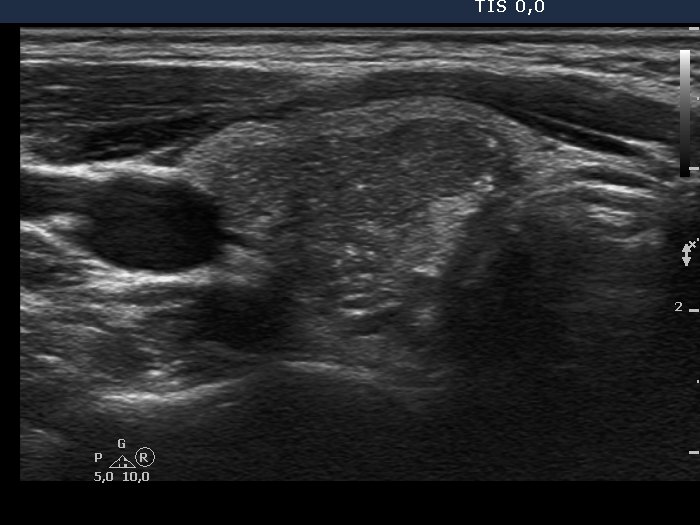
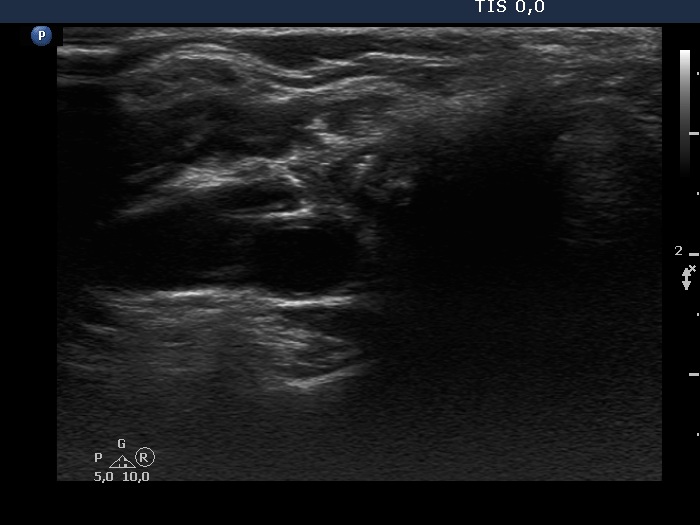
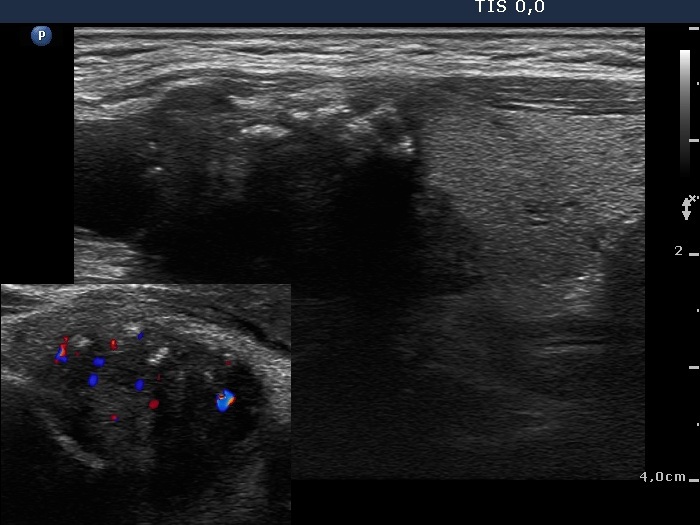
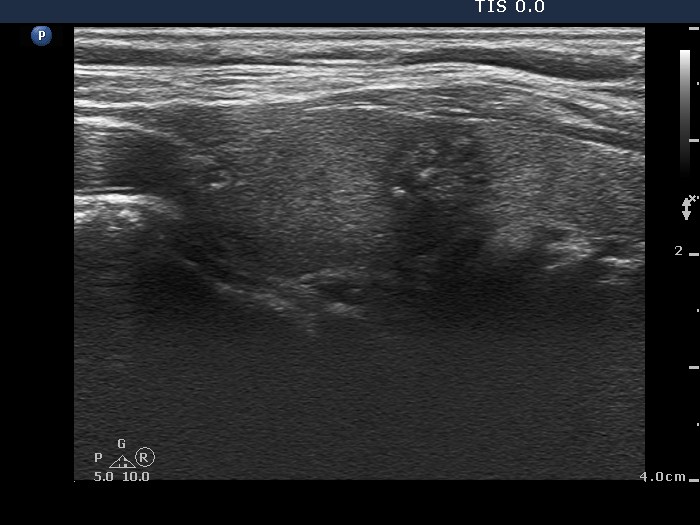
Hashimoto's thyroiditis (cytological diagnosis) - case 1137

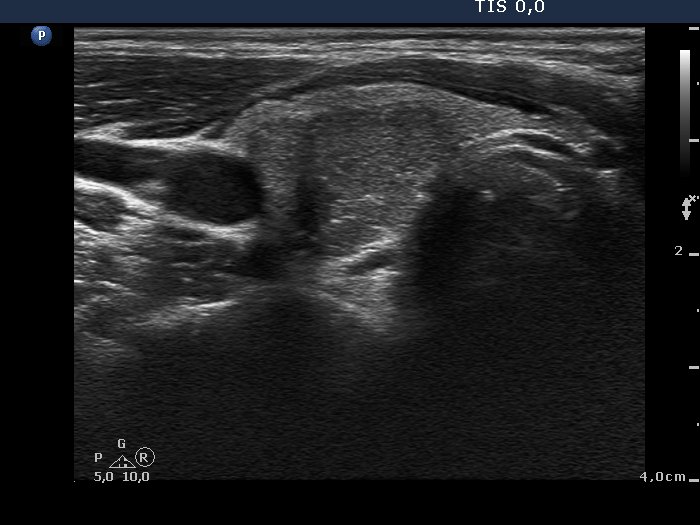
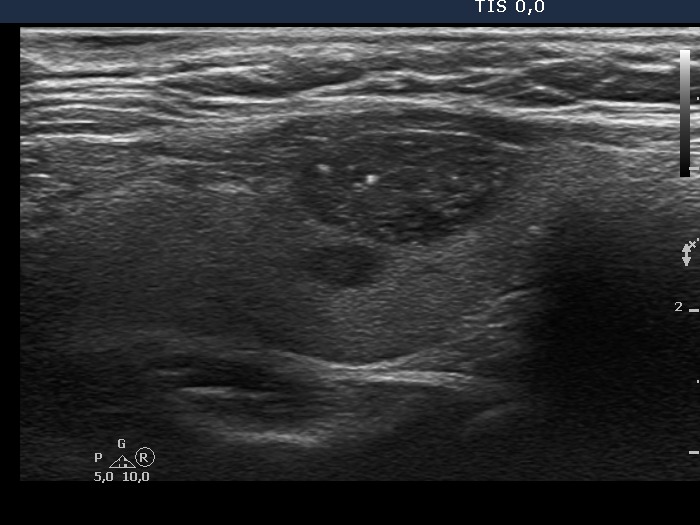
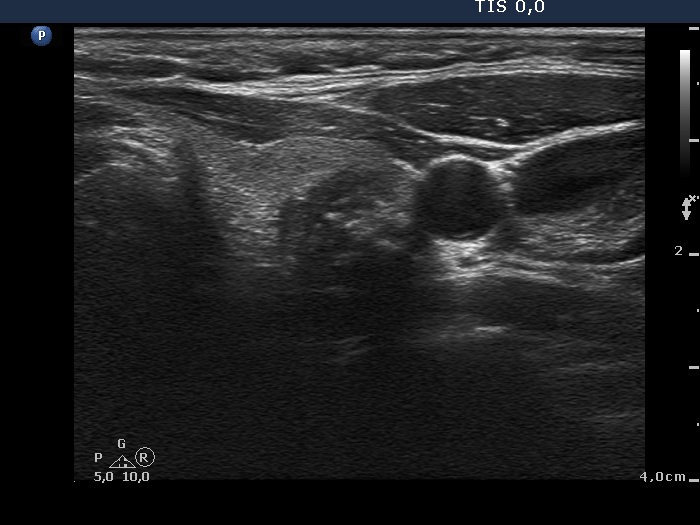
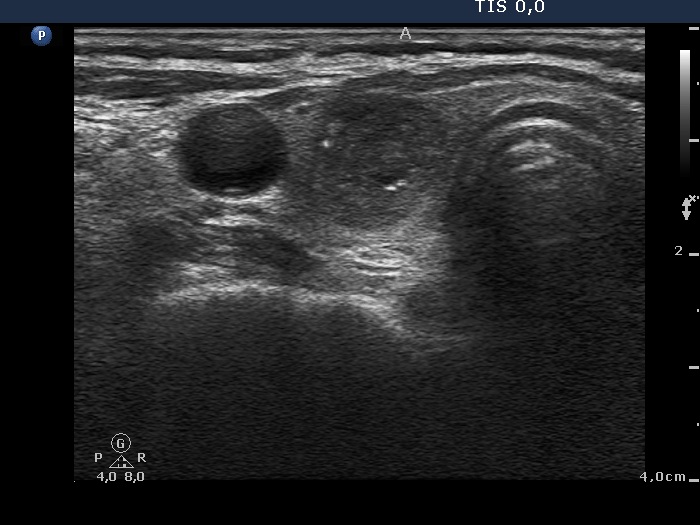
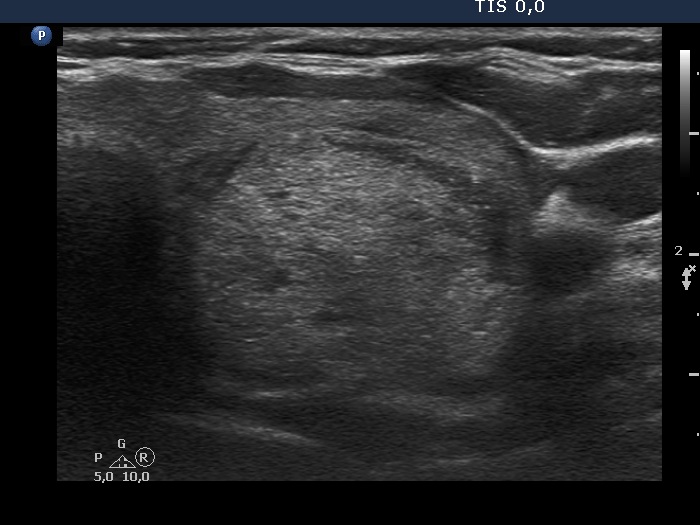
Papillary carcinoma (histological diagnosis) - case 1627

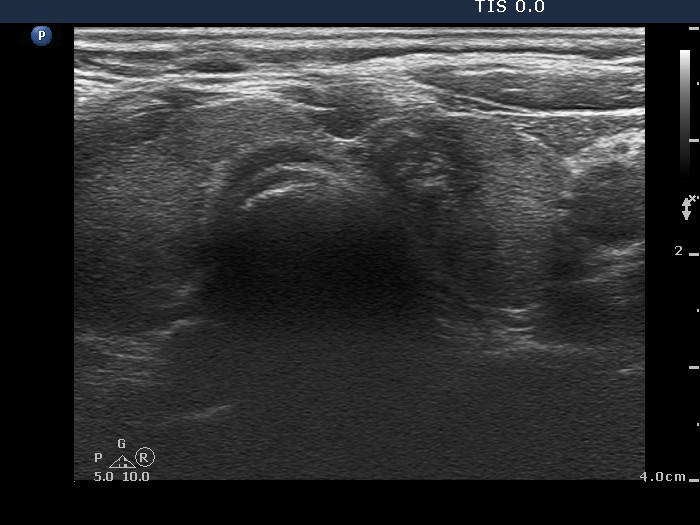
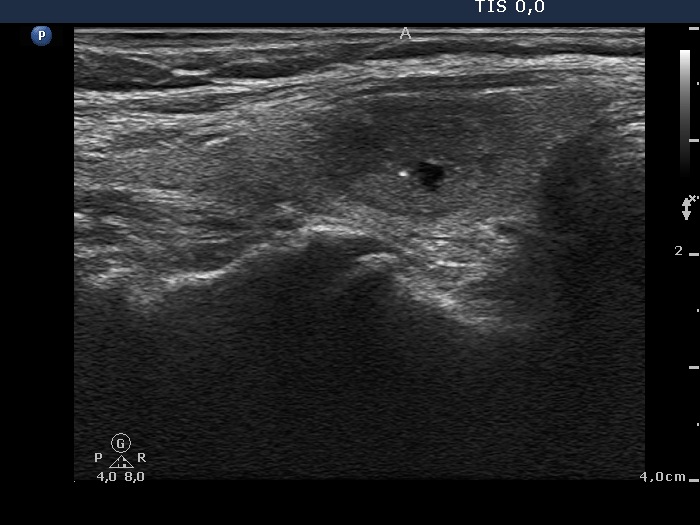
These lesions have a very similar ultrasound presentation, both are very hypoechoic and present with nonparallel orientation.

The left lesion lacks hyperechogenic figures. The borders are sharp and puzzle-like, a frequent finding in hypoechogenic discrete areas of Hashimoto's thyroiditis.

There are two pale figures in the dorsal part of the right nodule. It was very hard to decide even analyzing the video whether this figure is a line or two or three tiny granules next to each other. However, the nodule has two additional suspicious features: the taller-than-wide sign and the blurred borders.


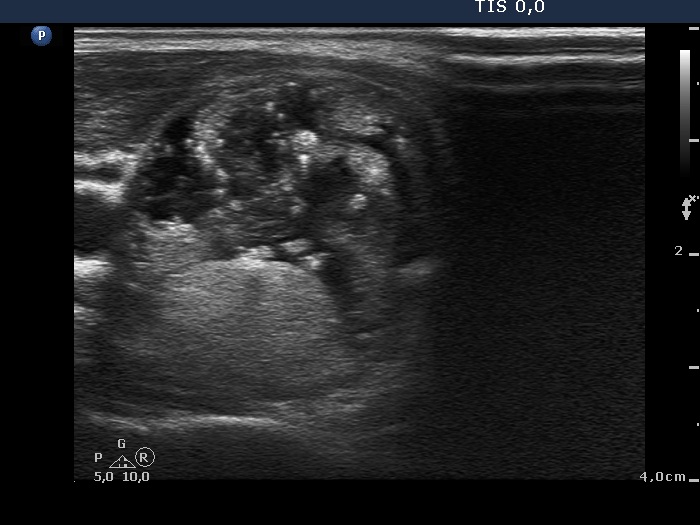
Oxyphilic adenoma - case 60

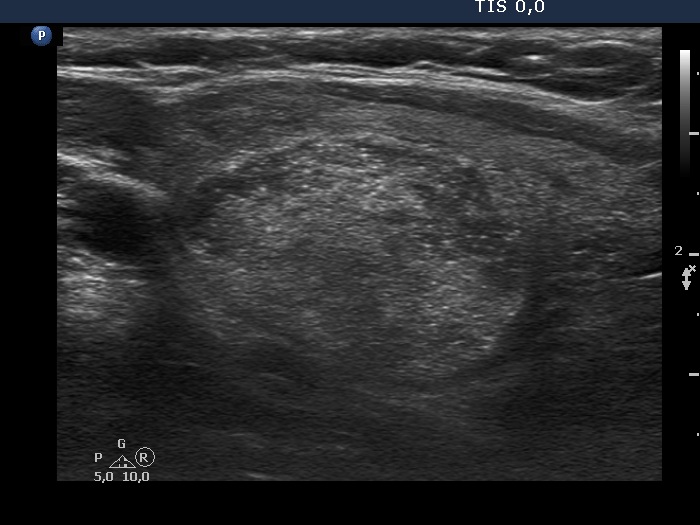
Papillary carcinoma - case conp 078

There are similar figures in both cases: beside presentations of connective tissue, punctate echogenic foci are found in the form of bright hyperechogenic granules. Although, the ultrasound presentations of these cases are similar, there are two important differences between them: the benign lesion has regular shape and sharp borders while the malignant lesion has irregular shape and blurred borders.


Intrathyroidal parathyroid adenoma (histological diagnosis) - case 1399

Papillary carcinoma (histological diagnosis) - case conp 031

There are a few hyperechogenic granules within the small parathyroid lesion and we can see two much thinner lines, as well. These figures might be either punctate echogenic foci or non-specific granules. The papillary carcinoma contains punctate echogenic foci. The main differences between the appearance of the cases are the shape and borders: regular and sharp in the left benign, while irregular, blurred in the right malignant focus.
   

Benign colloid goiter - case cons100_001

Papillary carcinoma (histological diagnosis) - case conp 035

The thyroid presented in the left images is composed of moderately hypoechogenic and hypoechogenic nodules, while the lobe in the malignant case is diffusely hypoechogenic and has a less hypoechogenic but more inhomogeneous lesion in its dorsal part. Both the left thyroid and the malignant nodule in the right images have hyperechogenic granules and lines which correspond to a connective tissue.


Benign hyperplastic nodules (histological diagnosis) - case 444

Papillary carcinoma (histological diagnosis) - case conp 002

Both lesions contain bright granules and lines, i.e. proliferation of connective tissue. The simultaneous presence of punctate echogenic foci (microcalcifications) cannot be excluded in either case. The ultrasound presentations differ in the shape and borders of the nodules. In contrast with the benign lesion, the malignant nodule is lobulated and has blurred borders in its dorsal part.


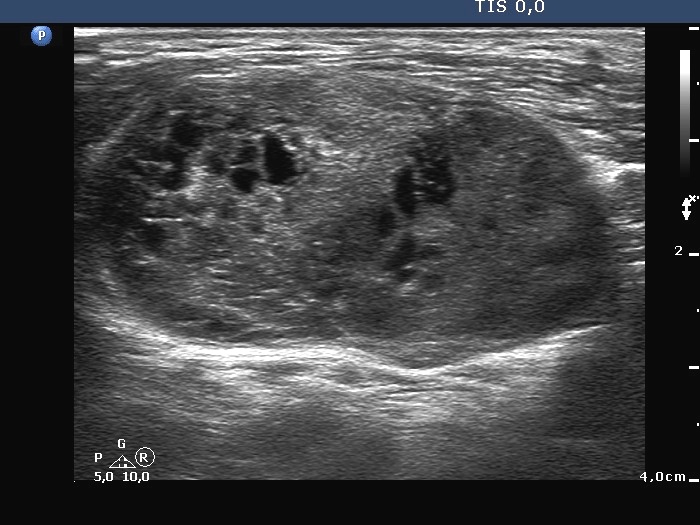
Oxyphilic adenoma (histological diagnosis) - case 1735

Papillary carcinoma (histological diagnosis) - case conp 050

Both lesions have multiple cystic areas including spongiform areas. Note that both cases presented signs of posterior acoustic enhancement, i.e. hyperechogenic figures in the back wall of the microcystic areas. The risk of malignancy is very low in such lesions if there are no signs suggesting an increased risk. Because the solid part was hypoechogenic in these nodules, aspiration cytology was indicated. There were two important differences between the cases. Firstly, the benign nodule was located within the thyroid, while the malignant was found in a lateral aberrant thyroid tissue. The latter increases the risk of malignancy. There was another important feature in the right, malignant case. The entire nodular area was composed of two parts which differed both in echogenicity and the proportion of cystic areas. The right side of the nodule was more hypoechoic and had less cstic portions compared to the left part of the lesion.


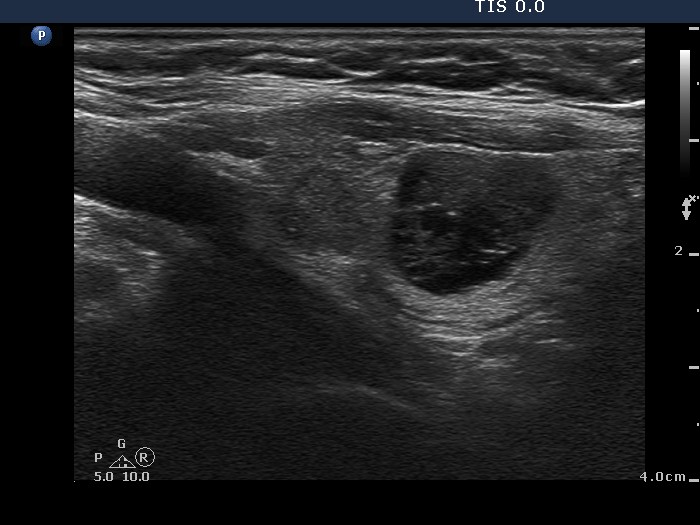
Benign hyperplastic nodule (histological diagnosis) - case 80

Papillary carcinoma (histological diagnosis) - case conp 057

The two cases differ in the lack and presence of punctate echogenic foci, benign (left) and malignant (right) case, respectively.


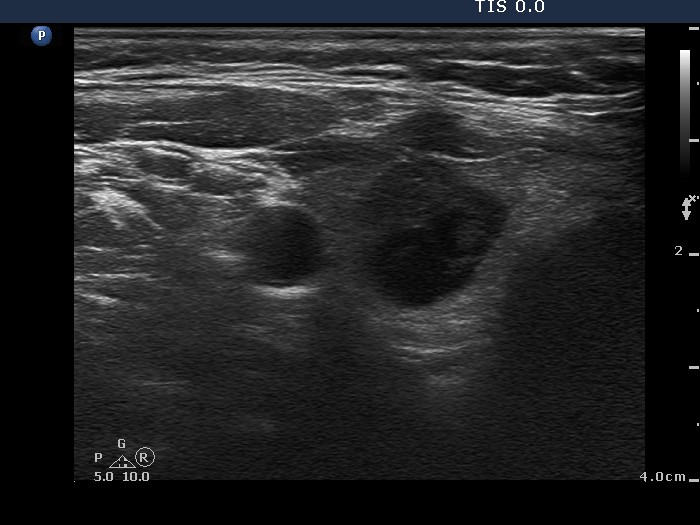
Benign hyperplastic nodule (histological diagnosis) - case 1091

Benign hyperplastic nodule (histological diagnosis) - case conp 026

Both spongiform cysts present hyperechogenic figures including fibrosis and posterior back wall enhancement, the left benign lesion does comet-tail artifacts, too. Both lesions had to be aspirated because the solid part of them was hypoechogenic. (The left case seems to have blurred borders but this is only an optical artifact because of inappropriate freezing. See video.)


Benign hyperplastic nodule (histological diagnosis) - case cons100_024

Papillary carcinoma (histological diagnosis) - case conp 005

Both cases have hyperechogenic granules and lines, i.e. proliferation of connective tissue, while the malignant nodule contains much larger and brighter granules, too. The latter correspond to punctate echogenic foci (in this case to microcalcifications). There are other differences between the cases regarding the borders of the nodules: the benign has regular, sharp while the malignant has irregular, blurred borders.


Follicular adenoma (histological diagnosis) - case 11

Papillary carcinoma (histological diagnosis) - case conp 009

The two nodules do not differ neither in the presentation of hyperechogenic figures (which might correspond either to connective tissue or punctate echogenic foci) nor in their shape. Moreover, both are blurred.


Granulation around surgical thread (cytological diagnosis) - case 1343

Papillary carcinoma (histological diagnosis) - case conp 045

There is a minimal if any significant difference between the ultrasound presentations of these cases: both were irregularly shaped and hypoechogenic, both contained various hyperechogenic figures including compound ones composed of echonormal ragged tissue having bright granules. This striking similarity is the cause for the differential diagnostic issue in the event of granulation around surgical thread. Naturally, the patient history decides this issue.


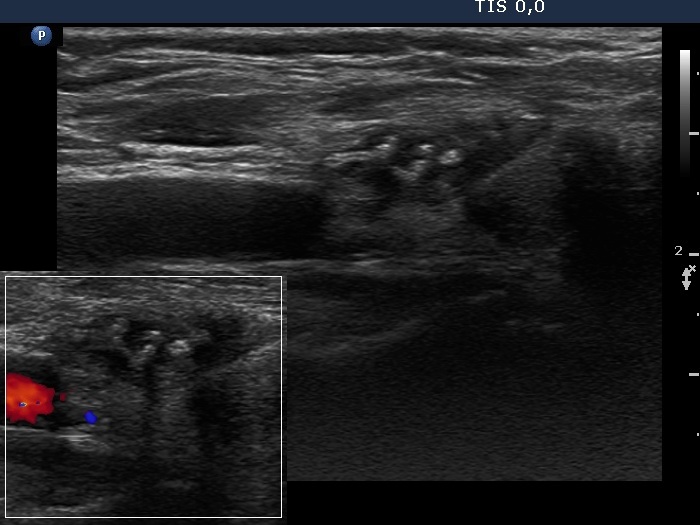
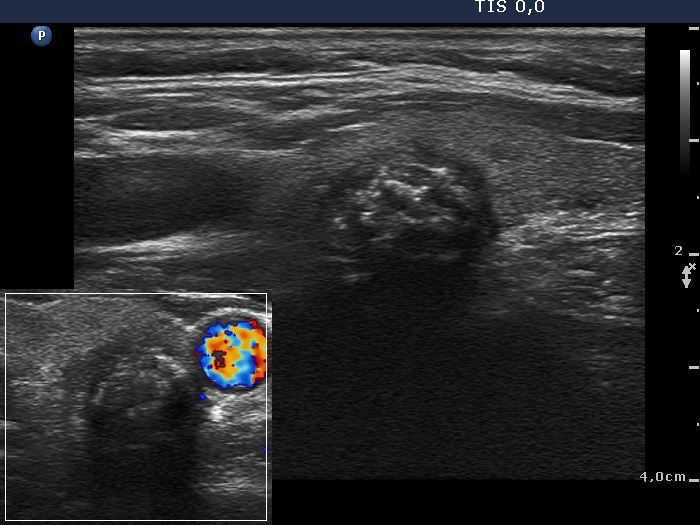
Granulation around surgical thread (histological diagnosis) - case 411

Papillary carcinoma (histological diagnosis) - case 779

Here is another example of the differential diagnostic problem caused by granulation around surgical thread. Again, there is no significatn difference between the ultrasound presentations of these cases except for the vascularization. The right, malignant case cannot be a granulation around surgical thread which is always avascular; however, this is not a great revelation in a patient who has not been operated. Conversely, the lack of vascularization by no means excludes the possibility of a carcinoma.


Oxyphilic adenoma (histological diagnosis) - case 368

Papillary carcinoma (histological diagnosis) - case conp 028

The left benign lesion contains a punctate echogenic focus while the right, malignant does proliferation of a connective tissue. The benign lesion has a regular shape and sharp borders, while the malignant nodule has irregular shape and blurred borders.


Follicular adenoma (histological diagnosis) - cons_operated case 072

Follicular adenoma (histological diagnosis) - case 424

The nodule contains numerous hyperechogenic granules and a few lines and it is possible that the former correspond to punctate echogenic foci. On the other hand, the nodule has a regular shape which would be an unusual finding in a cancer having such a great number of microcalcifications. Nevertheless, the risk of carcinoma is greater compared with an average, dominantly echonormal nodule.

The large spots in the range of 2 to 4 mm are ragged thyroid parenchyma as are most of the smaller similar figures in the upper image. It is reasonable to assume that the smaller granular figures are also ragged parenchyma. On the other hand one of them fulfills the criteria of a comet-tail artifact. The bright granules in the right and upper side of the moderately hypoechogenic part of the lesion are punctate echogenic foci (lower image).


Benign colloid goiter (cytology) - case 1332

Papillary carcinoma (histological diagnosis) - case conp 027

The nodule presented in these cases are very similar, indeed there is no obvious difference between the presentations. The brightest echogenic spots are punctate echogenic foci in both cases. While the less bright lines and granules correspond to back wall figures.