
|
|
Chronic lymphocytic thyroiditis - Case 18.
|

|


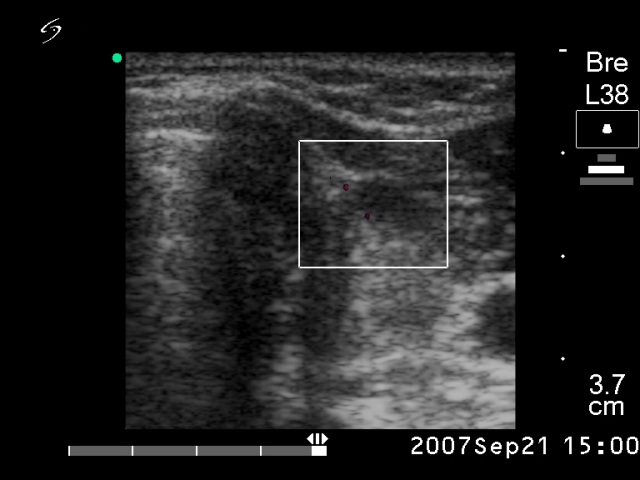
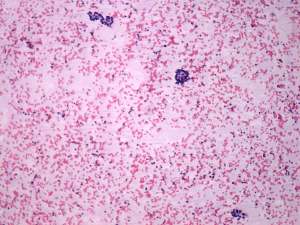

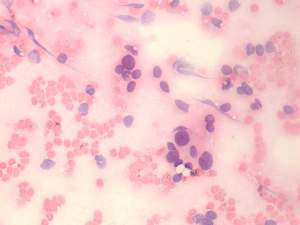

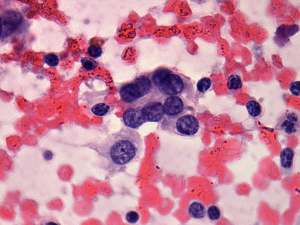


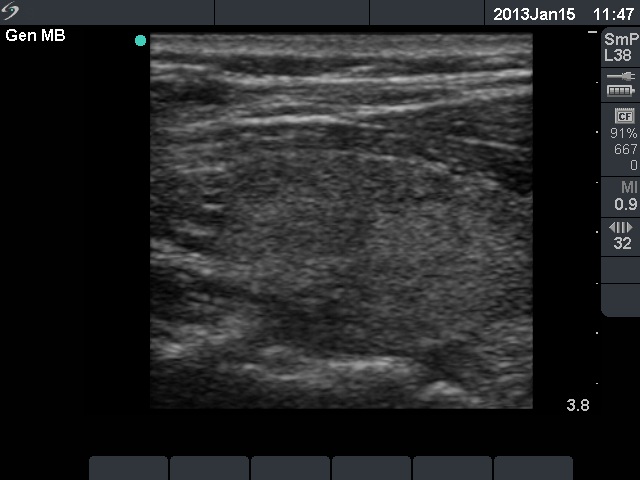
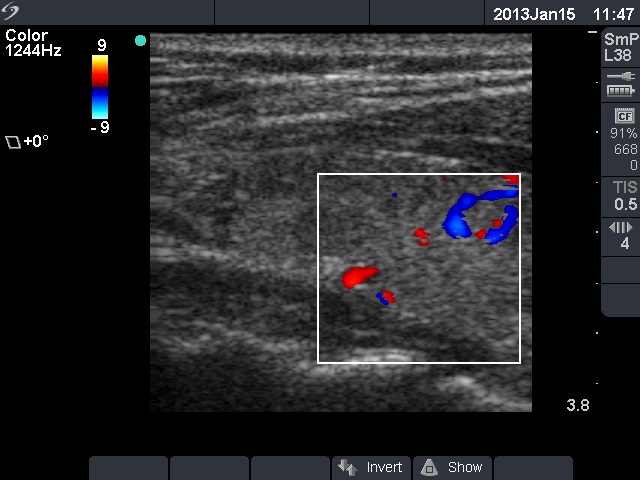


First examination (1st and 2nd rows of images):
Clinical presentation: a 59-year-old woman requested a second opinion. Ultrasonography was performed because of her neck complaints and a hypoechogenic nodule was found. Aspiration cytology yielded a "C3" result, the cause of the suspicion was the presence of microfollicular structures on the smear.
Palpation: no abnormality.
Functional state: euthyroidism with TSH-level 3.96 mIU/L.
Ultrasonography: the thyroid was echonormal with multiple hypoechogenic areas. The echogenicity index was around 25%.
Cytology was performed and Hashimoto's thyroiditis was diagnosed.
We performed aTPO test (304 U/mL).
Suggestion: we suggested regular follow-up examinations instead of a surgery because the risk of thyroid cancer other than papillary microcarcinoma was estimated as less than 1%.
Follow-up examination in 2011 and in 2013: (3rd and 4th rows)
Functional state between 2007 and 2013 : the TSH practically did not change over the 6 years of the follow-up period, it was in the range from 2.97 to 4.98 mIU/L without any tendency.
Anti-TPO: was determined in every two years between 2007 and 2013, and resulted in 304, 22, 287 and 107, in 2007, 2009, 2011 and 2013, respectively.
Ultrasonography between 2007 and 2013 : the pattern in 2013 was practically identical to that seen 6 years earlier except for the vascularization. The latter was in the range from absent to increased without any tendency. There was correlation neither between vascularization and TSH nor between vascularization and aTPO level.
Comments.
-
The sonographic pattern of lymphocytic thyroiditis is stable. More stable than the aTPO level. Compare the sonographic images performed in 2007 with that performed in 2013.
-
The greatest task of thyroid cytology is not to operate a patient unnecessarily. Microfollicular proliferation can be observed in every disorder of the thyroid and even in normal thyroids.
-
The greatest problem in thyroid sonography is the correct interpretation of circumscribed hypoechogenic areas which are found in more than 85% of Hashimoto's thyroiditis.


