
|
|
Study on 100 consecutive patients with thyroid nodule - case 058
|

|


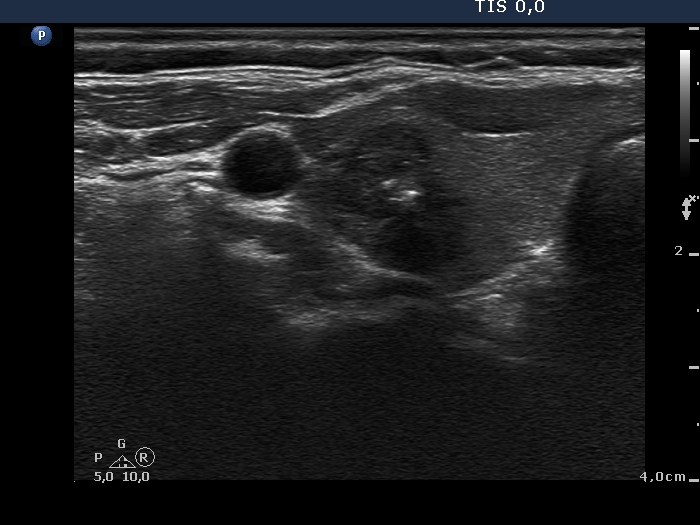
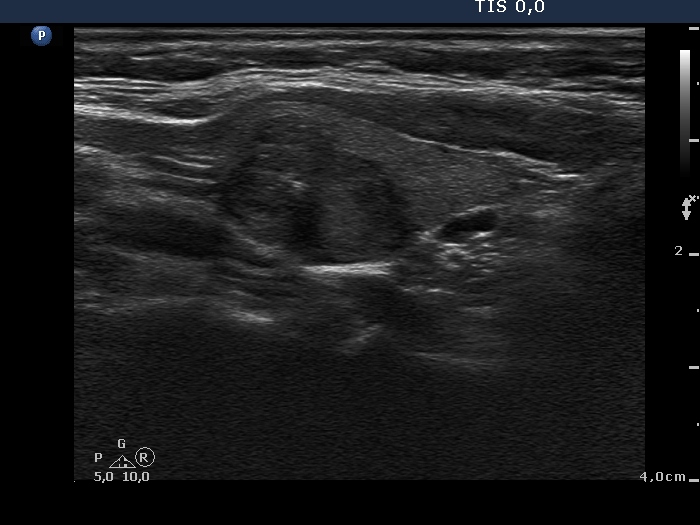


Clinical presentation: A 53-year-old woman was referred for evaluation of a nodular goiter detected on screening.
Palpation. The surface of the right lobe was uneven. No nodule could be palpated.
Functional state: euthyroidism (TSH 1.92 mIU/L).
Ultrasonography. The thyroid was echonormal. There was a hypoechogenic mass in the right lobe. The mass was composed of multiple discrete lesions. The borders were partly blurred. The lesion had hyperechogenic figures, increased intranodular blood flow and presented cystic degeneration.
Aspiration cytology was performed from the nodule and we gained a minimal amount of brown fluid. The cytological pattern itself was not reassuring.
We took the ultrasound presentation into account and gave a common ultrasound-cytological diagnosis of suspicion of papillary carcinoma.
Total thyroidectomy was performed. Histopathology disclosed papillary carcinoma.
Comments.
- The cytological pattern itself was not enough to a definite carcinoma diagnosis. The complete lack of inclusion is a very rare phenomenon in the event of a papillary carcinoma. Moreover, there were only scattered number of nuclei with groove and there was no one typical papillary cluster on the smear. Although the nuclear crowding, the irregular chromatin structure and the mild pleomorphism are only weak signs of malignancy, the presence of all of these features together are remarkable.
- The combination the cytological data with the ultrasound presentation led to the combined ultrasound-cytological diagnosis of suspicion of papillary carcinoma.
- The interpretation of the intranodular hyperechogenic figures is not simple. On thorough analysis of the video it seems more likely that these correspond to proliferation of connective tissue because of the simultaneous presence of bright lines and granules.
- Regarding the nodule borders the degree of blur is below 50%. The irregularities and spiculations cannot be clearly judged. The undulated surface of the mass is caused not by pathological lobulated margins but simply by the presence of multiple lesions next to each other.


