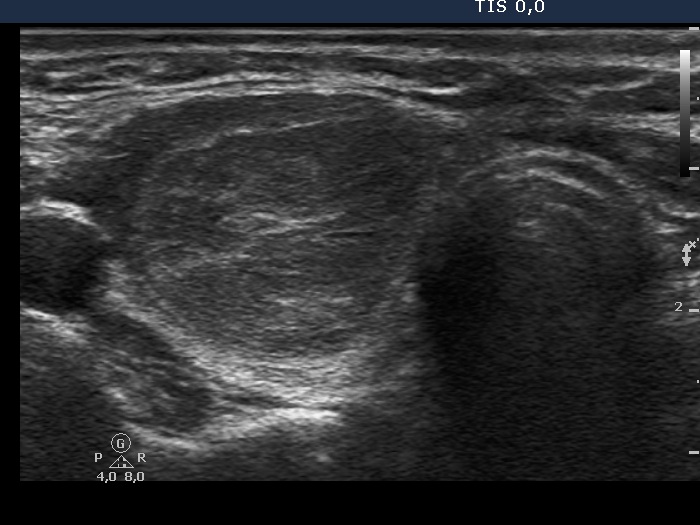
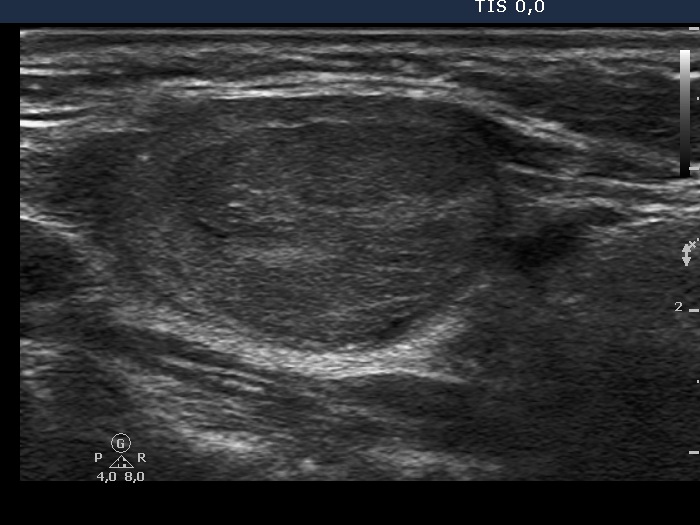
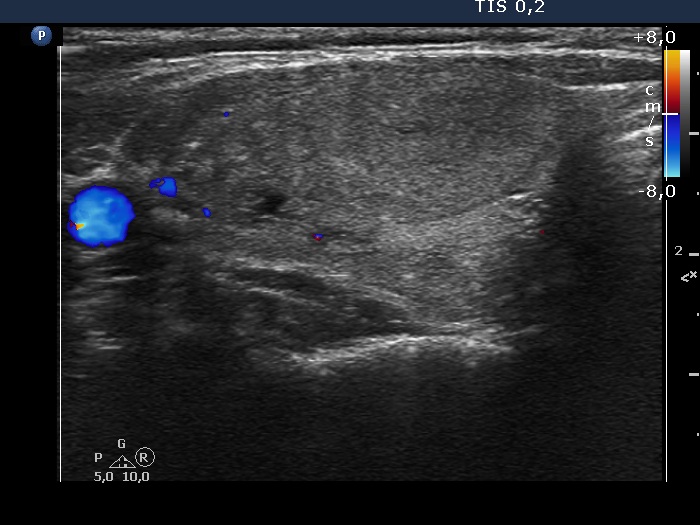
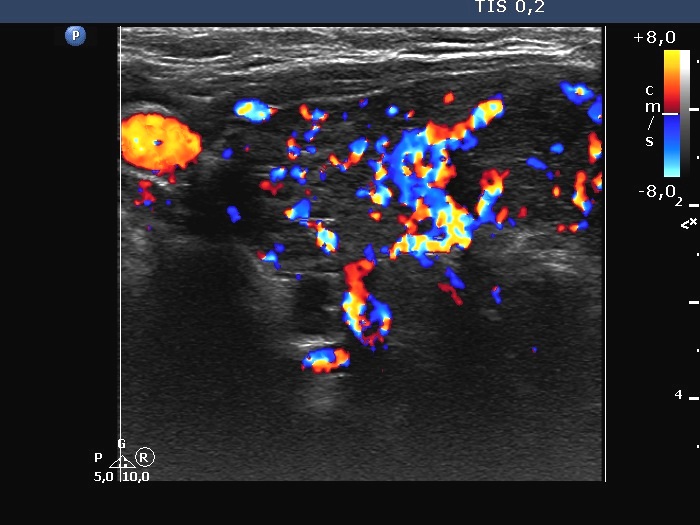
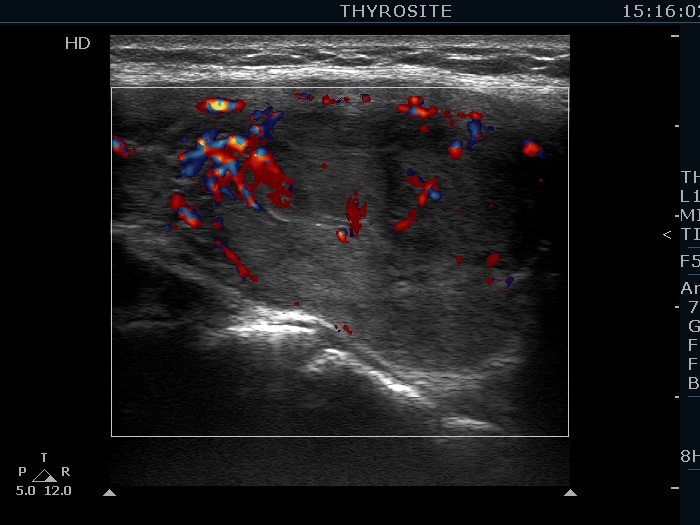
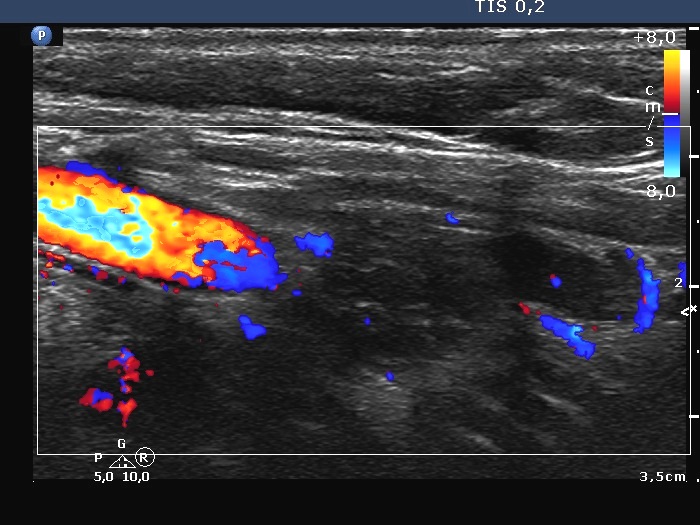
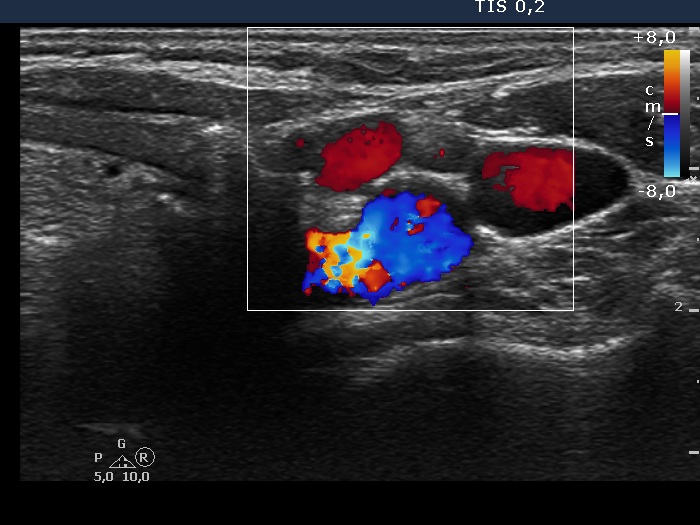
The nodule did not present halo sign while clearly has perinodular vascularity. If both features would absent then the risk of follicular tumor would be very low.
These cases reveal an opposite situation. The nodules had halo but lacked and had minimal perinodular flow, right and left case, respectively.
Papillary cancer in Hashimoto's thyroiditis (histology) - case conp 079
Benign parts of the lobe
The papillary cancer focuse
The right lobe was composed of several discrete hypoechoic lesions. The dorsal one proved to be papillary cancer. There was the most important difference in vascularity between the tumorous and non-tumorous lesions, the blood flow was substantially lower in the former.
Follicular adenoma in Hashimoto's thyroiditis (histology) - case 50
The lesion in the ventral part proved to be a follicular adenoma. This part of the lobe is suspicious on grey-scale mode being a pathological nodule. This suspicion was further increased by the Doppler examination, the lesion differed in vascularity form other parts of the lobe.
There is a nodule in the ventral part of the lobe. The nodule has spread into the sternocleidomastoid muscle. On grey-scale mode (right upper image), we could misinterpret the hypoechoic mass ventral to the thyroid as a muscle fiber. However, Doppler mode proved that this indeed cannot be a muscle fiber because a muscle does not show vascularity.
Hashimoto's thyroiditis without any nodules (histology) - case 1646
The patient was diagnosed having a follicular neoplasm in the ventral hypoechoic lesion. However, this show neither halo nor perinodular blood flow. This pattern minimizes the possibility of follicular tumor even if cytology suggests follicular tumor.
The vascularity plays an important role in the recognition of lymph nodes. In this case, a lymph node was located between blood vessels. The node could be easily identified by examining the circulation.