
|
|
Lymph nodes in the neck - Case 12.Metastasis of an oxyphilic carcinoma of the thyroid
|

|


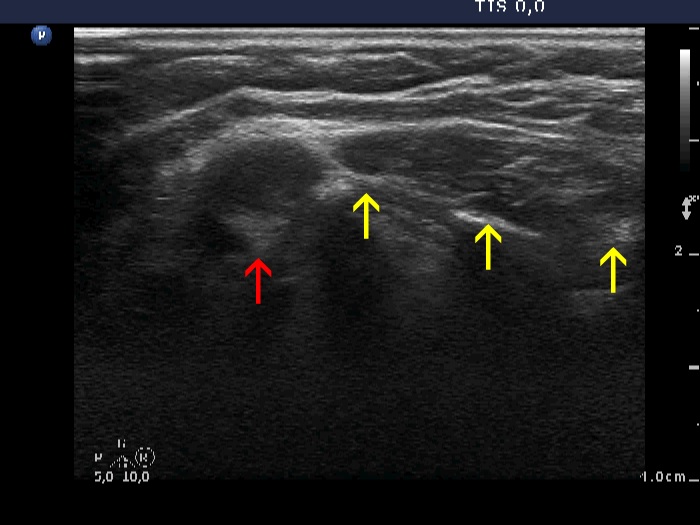
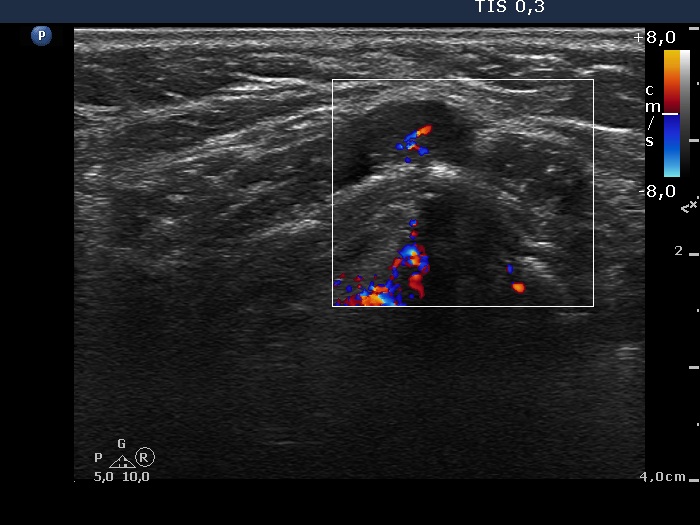

Clinical data: a 49-year old woman requested not a second but a fifth opinion. She was operated on "Hürthle-cell carcinoma" of the thyroid for 19 years. She underwent on total thyroidectomy and external irradiation. She was disease free in the following period. Serum thyroglobulin level was undetectable while anti-hTG was in the range of 49 to 271 U/mL without any tendency. She noticed a lump in the middle of the neck 5 cm above the thyroid level for 3 months. She vainly searched for a specialist who would be able to give a diagnosis without aspiration cytology because she was afraid of a potential tumor spread after an aspiration.
Palpation: a firm node above the thyroid.
Functional state: euthyroidism on daily 125 microgram levo-tiroxin (TSH 0.91 mIU/L, FT4 17.1 pM/L, serum-thyroglobulin undetectable, anti-hTG 57 U/mL).
Ultrasonography was performed. The patient refused to undergo on examination of the thyroid region in order to minimalise the harm of ultrasonography. We tried to explain her without any success that we cannot cause any harm with an ultrasound examination. A hypoechogenic lymph node was present above the thyroid without a regular hilum.
We required another 45 minutes to convince her that an aspiration cannot cause spread of the tumor. Finally, the patient opted in. At the moment of aspiration the patient felt an extraordinary weakness, she cried and became extremely nervous for 2 minutes. Thereafter her complaints suddenly stopped. Me and my assistant could not make a smear because we had to struggle for the patient's problem and the material dried in the needle in the 2 minutes of uncomfortable feeling of the patient. We did not try with a second aspiration... We made a needle wash out. Wash-out thyroglobulin was 87.9 ng/ml.
Surprisingly, the patient was not opposed to surgery.
Histopathology disclosed oxyphilic variant of papillary carcinoma.
Comments.
-
Patients are not rarely afraid of a supposed tumor spread caused by an aspiration. A few case studies prove that this side effect cannot be excluded. However, this is an extremely rare situation with an estimated risk less than 1:100,000.
-
I did not read any publications in the literature focusing on the effect of adverse reactions of patients on the efficacy of aspiration cytology. However, this is a real problem. In 1 in every 10 to 20 attempts the aspiration fails because of the reaction of the patients. An adequate communication may have diverse effect. It can decrease the anxiety of patients. Nevertheless, great proportion of the patients react oppositely, it means more than 50% on my experiences. They want to be over the procedure as soon as possible, and the delay caused by the enlightenment increases their fear.
-
It is well-known that serum-tireoglobulin determination has only limited role in the event of an oxyphilic thyroid tumor and in those cases where the patient produces anti-hTg antibody. Both circumstances occurred in this patient. Theoretically, the elevation of anti-hTg may have a similar role to tireoglobulin in the follow-up of patient operated on well-differentiated thyroid carcinoma. This case study stands against the usefulness of anti-hTG determination in the follow-up.


