
PAPILLON COURSE on THYROID ULTRASOUND
Section 2 The nodular goiter
Part 2 The composition of the nodule
Home
The first impression we get from a discrete lesion is the composition. A lesion can be solid, cystic or complex depending on the ratio of the cystic and solid portions. We focus in this chapter on the cystic lesions and their categorization and importance in the differential diagnostic.
This course is composed of several parts. It is advised follow the order of the parts.
-
Introductory course briefly describes the various types of nodules according to their composition, discusses the subtypes of cystic nodules, and their role in various forms of thyroid carcinoma and in different TIRADS.
-
Manual serves as a guidance for the reader. The manual can be downloaded in pdf format.
-
Lectures present the different forms in detail and give an approach to differential diagnostic. This is one of the most time-consuming parts of the topic.
-
Case study is composed of dozens of cases most of them presents beside 5 to 15 ultrasound images ultrasound videos, as well.
-
Videolibrary serves the goal of testing the skills by analyzing videos.
- If you visit the Exam, you can test your skills.
Case study of the topic
A 33-year-old man requested a second opinion. He has noticed a lump in the neck for a year. Aspiration cytology resulted in benign lesion. According to a mass in the middle part of the neck, a cystic lesion was found on ultrasound. It ha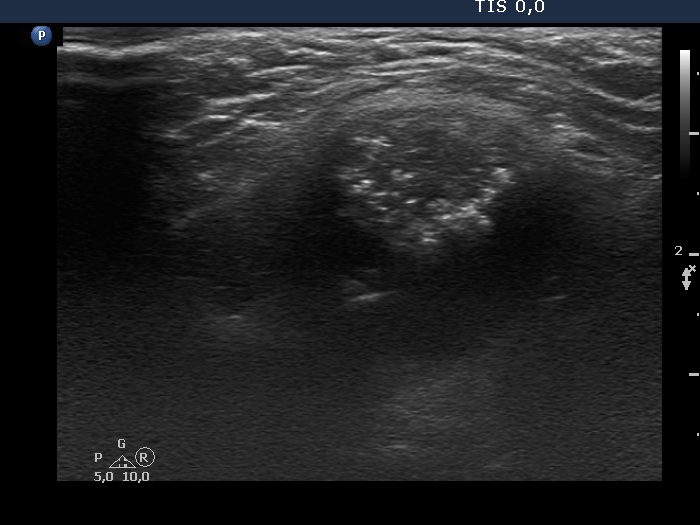 d a hypoechogenic solid part presenting numerous punctate echogenic foci, great proportion of them were related to tiny ventral cystic areas. Aspiration cytology was performed form the neck mass. We saw a very cellular smear without pathognomonic nuclear signs of papillary carcinoma.
We performed wash-out thyroglobulin determination which yielded > 486 microgram/L. Our combined clinical-ultrasound-cytological diagnosis was suspicion of papillary thyroid carcinoma.


