Benign hyperplastic nodules - Case 25 |
 |
 |
 |
 |
|
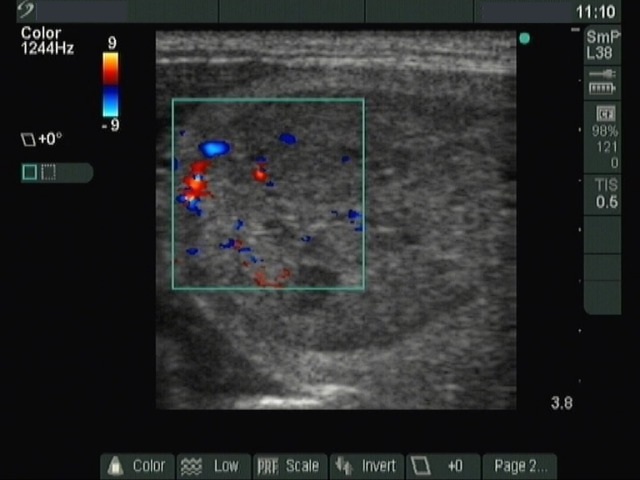
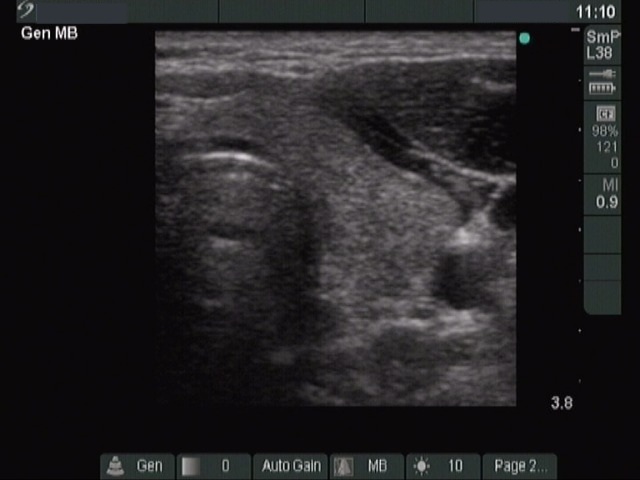
There was an autonomously functioning
nodule in the right thyroid (upper images and left lower image). The echogenicity of a toxic nodule is not
specific, a relatively greater proportion of such lesion is
moderately hypoechogenic or more hypoechogenic than echonormal or
hyperechogenic. Most toxic nodules present a halo sign and a combined type 2 and type 3 vascular
pattern, i.e. both perinodular and intranodular blood flow. An
atrophic contralateral lobe (right lower
image in this patient) is also a typical property.
|
| |
|
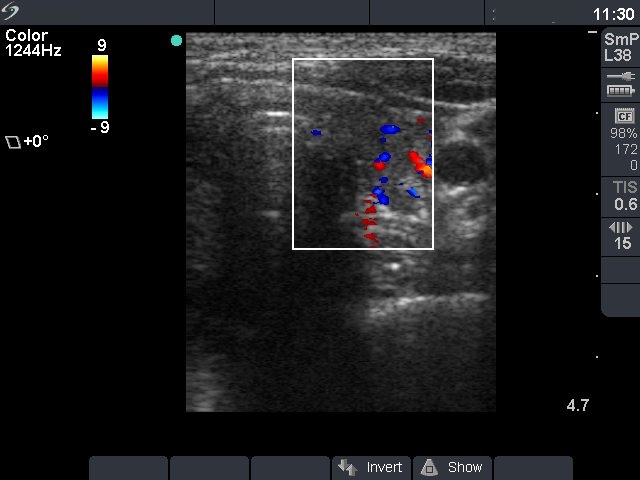
A patient with Marine-Lenhart syndrome.
Graves' disease - Case 17 |
|
Right lobe
|
Left lobe
|
 |
 |
 |
 |
|
A mixed echonormal-hypoechogenic nodule
is presented with a halo sign. Note that the extranodular part of the
lobe is hypoechogenic.
|
This lobe is hypoechogenic and
atrophic. The vascularization is increased. |
|
Marine-Lenhart syndrome means the
combination of an autonomously functioning adenoma and Graves'
hyperthyroidism. The most important sonographic property of this
disease is the hypoechogenicity of the extranodular part with increased
vascularization. It is very important to recognize the concomittant
autoimmune hyperthyroidism in order to initiate the appropriate type of
surgery, i.e. bilateral thyroidectomy instead of lobectomy. In most
cases without thyroid associated orbitopathy, the toxic nodule comes to
the front and we have the best chance to recognize the Graves' disease
by thorough analysis of the echo pattern.
|


