
|
|
Papillary carcinoma - Case 22.
|

|


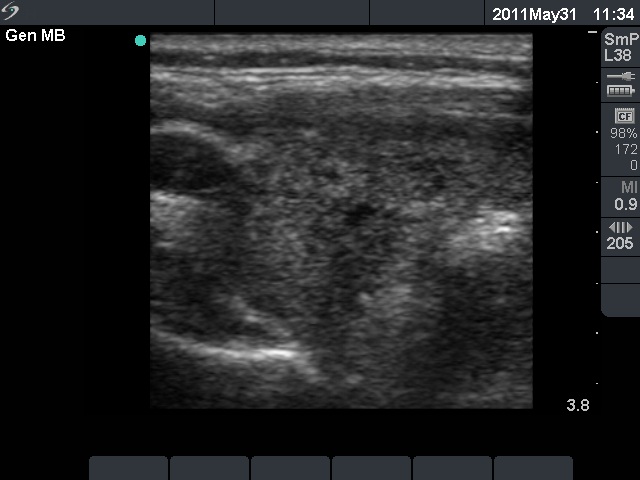


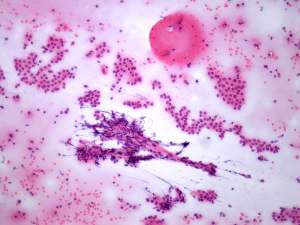
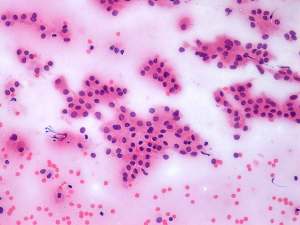

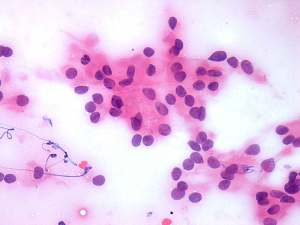

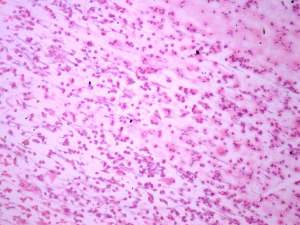


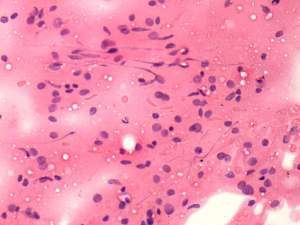
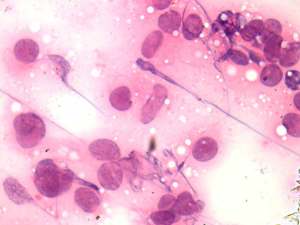


First examination (1-3. rows of images)
Clinical data: a 35-year-old woman treated for hypothyroidism requested a second opinion. Her hypothyroidism was known for 2 years. At the last visit, ultrasonography was performed and a hypoechogenic nodule was detected in the right thyroid. Aspiration cytology was not diagnostic.
Palpation: both thyroids were firm. There was no palpable nodule.
Functional state: euthyroidism on daily 75 microgram levo-tiroxine (TSH-level 3.09 mIU/L).
Ultrasonography: both thyroids were moderately hypoechogenic with numerous small more hypoechogenic areas. There was a larger hypoechogenic lesion in the lower part of the right lobe. The lesion had irregular borders and contained microcalcifications. The vascularization was decreased.
Cytology:
First row of cytological images - from the hypoechogenic lesion with irregular borders
Oxyphilic cells predominated the smear. Several nuclei contained inclusions and have irregular chromatin structure. Small number of lymphocytes occurred on the smear.
Cytological diagnosis: suspicion of papillary cancer.
Second row of cytological images - from the moderately hypoechogenic lesion
Heterogeneous lymphoid cells, nuclear debris and great number of dispersed oxyphilic cells predominate this smear. Follicular cells displayed pleomorphism, but did not inclusion or groove.
Cytological diagnosis: Hashimoto's thyroiditis.
Surgery was advised. The patient looked for a healer who advised not to get an operation. The healer administered a combination of various drugs and herbs.
Second examination 10 month later:
Clinical data: one year later the patient visited us again. She told us that the therapy of the healer was very good, the healer told her that the tumor regressed almost completely. We asked the patient how the healer measured the tumor. "With sensitive biomagnetic palpation", i.e. the healer put his hands on the neck of the patient for 5 minutes. The healer suggested another one year course of the former combination of drugs to completely cure the tumor. The problem of the patient was that she was not able to pay for this therapy which cost her six months salary.
Ultrasonograpy (last row of images):
The sonographic picture was unchanged (see video). We tried to explain based on our knowledge why to get operated, but we could not convince her completely. Nevertheless, the patient went on operation because she was not able to pay for further therapy of the healer. "It is better to do harm than do nothing in the case of a tumor" - this was the explanation of the patient why to go on surgery.Total thyroidectomy was performed.
Histopathology: a solitary focus of papillary microcarcinoma according to the nodule in the dorsal part of the right lobe. The maximal diameter of the carcinoma was 8 mm. Hashimoto's thyroiditis was found in both lobes.
Comments:
-
Seemingly, this story does not need any comments.
-
It is well-known that the incidence of papillary cancer is the most increasing human malignancy while the mortality does not increase. This fact has even ethical consequence, too. It is possible that 30 years later our progenies will think about us like we do now about such "healers" in the above story.


